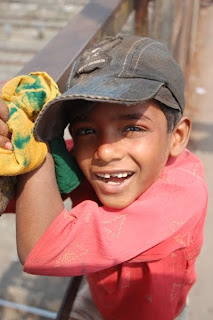
 “Hellooow! How are you?” screams a little girl, about 6, as she runs towards our group with her hands outstretched. We all take turns shaking her hand, and asking how she was in return. She had the biggest smile on her face, while her beaming mother is standing right behind her, nodding gently as each of us shuffle by. This scene is repeated over and over again, as children of all ages dart out from hidden doorways and alleys, yell “HI!” with a high pitched voice and a quick wave of their hand, before disappearing back into the alleys and crowds. This was not some playground, or neighborhood park. This was in the depths of the largest slum in Asia – Dharavi.
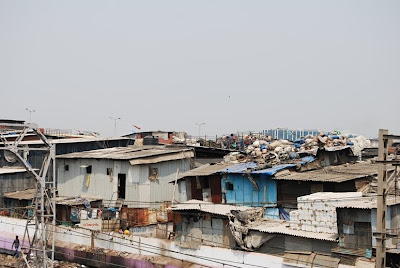
Dharavi, with over a million inhabitants, is the largest in Asia, and was recently featured and made famous in the movie Slumdog Millionaire. Located in the city of Mumbai, it generates an economic output estimated to be about US$665 million per year, although most of its population earns less than Rs. 300 or US$6 per day!
The slums are everything you imagine it to be - dirty, smelly, crowded. A maze of narrow passageways barely wide enough for two people to pass each other; trash strewn about everywhere; and when you come close to one of the canals or rivers, the strong stench of human excrement fills the air. But in spite of it all, I saw a community of people with the will to put up with anything to give their children a better life. Amid harsh working conditions, recycling plastic, tanning leathers, and making ceramic pottery to name a few, everyone we met greeted us with a smile and nod. From women rolling poppadoms to children picking through heaps of trash, they found it in them to pause, to wave, and for a moment, to show the world a little piece of their lives.
Reality Tours and Travel:
If you are ever in Mumbai, I highly recommend the Dharavi Slum Tours by Reality Tours and Travel. All proceeds go towards a Kindergarten and Community Center run by Reality Cares, a non-profit organization. There is a strict no photo policy during the tour. For pictures and details of the tour, visit their website.
Today, the colorful festival of Holi is celebrated all over India, marking the beginning of spring, and the triumph of good over evil. People celebrate by throwing water balloons and colorful powders at each other, smearing each other’s faces into a kaleidoscope of neon colors, hugging, and wishing each other “Happy Holi”.
What better way to celebrate this colorful festival of love and joy, than by joining the local neighborhood block party!!! Dressed in traditional white Indian Kurtas, wielding water guns and packets of colorful powders, we roamed the neighborhood, drawn to a small enclave of old apartment flats by the blaring sounds of Indian pop music and cheerful screams. What we found was a friendly community of teenagers and young adults dancing to the latest Bollywood music hits, welcoming us with smears of colors on our faces.
For more information on Holi, please visit the Holi Festival Website or Wikipedia.

After a short stop back in Singapore, I finally made it to India! The city of Mumbai (formerly Bombay) is everything all at once. Chaotic but colorful, smelly yet fragrant, from the glitz of Bollywood to the slums of Dharavi, this city is full of surprises!
Today, on my second day in Mumbai, my friend Bron and I decide to take the train from our friend’s home in the Bandra West neighborhood to South Bombay for a day of sight-seeing and exploration. Now taking the trains in India is not like hopping on the subway in New York. During rush hour on a weekday, the trains get so crowded that anyone making it on board will have to be content with being pressed against any object or person that is next to you. Fortunately, today is Saturday, and the trains were not nearly as crowded.
Being that this was our first time taking the train in India, we decided to splurge on a First class ticket as the First Class cabins are usually not as crowded. Costing a total of Rs 52 each, we easily navigated the Bandra Station and found our way onto the next train to Church Gate Terminus, thanks to a very detailed hand-drawn map and description provided by our good friend Brian who is living in India with his wife Jenn, both of whom are teaching at the American School of Bombay.
Because the trains do not have air conditioning, and it can get stifling hot in the cars, many commuters choose to stand by the doors, which remain open even while the train is in motion. This makes for a breezy, yet exhilarating ride as we thunder past the Mumbai streetscape.
On the way back, we decided to risk it and get a Second Class ticket instead. At Rs 6 each for a ticket, this was a steal, and fortunately, being the weekend, we even managed to find a seat, and rode comfortably back to Bandra.


 “Hellooow! How are you?” screams a little girl, about 6, as she runs towards our group with her hands outstretched. We all take turns shaking her hand, and asking how she was in return. She had the biggest smile on her face, while her beaming mother is standing right behind her, nodding gently as each of us shuffle by. This scene is repeated over and over again, as children of all ages dart out from hidden doorways and alleys, yell “HI!” with a high pitched voice and a quick wave of their hand, before disappearing back into the alleys and crowds. This was not some playground, or neighborhood park. This was in the depths of the largest slum in Asia – Dharavi.


 Posts
Posts

